
Private Capital Allocation Strategy: A Framework for 2026
Originally published at:

Key Takeaways
- Define the role private investments should play in your broader portfolio before assessing individual opportunities.
- Compare private equity, private credit, real estate, and infrastructure by portfolio purpose, structure, and risk profile.
- Build liquidity planning around capital-call timing, uncertain exit windows, valuation intervals, and limited secondary options.
- Use a private capital allocation strategy with clear objectives, allocation parameters, consistent underwriting, and scheduled reviews.
- Tailored portfolio and real-asset advisory can help connect strategic objectives with deal-by-deal decisions.
Table of Contents
What a Private Capital Allocation Strategy Is, and What It Must Achieve
A private capital allocation strategy is the disciplined process of assigning private investments a defined role, scale, and set of conditions within a portfolio, in line with its objectives and constraints.
What role can private capital play in a portfolio?
Which investor constraints should come first?
How Private Capital Allocation Connects Portfolio Objectives to Asset Roles
Asset-class labels describe what an investment is; they don’t explain why it belongs in a particular portfolio. Allocation should follow the economic role each holding is intended to serve, not the name attached to it. That distinction helps investors compare opportunities by purpose while accounting for differences in cash flows, valuation, and liquidity.
How do private-market asset classes differ in portfolio function?
How should public and private exposures fit together?
A disciplined private capital allocation strategy therefore maps intended roles across the whole portfolio, then tests whether each proposed holding contributes a distinct exposure or compounds an existing one. Investors assessing private and public positions together can use real-asset advisory to bring portfolio objectives into the discussion before moving to opportunity-level analysis.
Does Private Capital’s Illiquidity Make Allocation Too Risky?
Allocation capacity is determined by liquidity needs and the ability to meet obligations, not by headline return targets. A disciplined private capital allocation strategy must account for the possibility that cash flows arrive later than anticipated or not on the schedule an investor would prefer.
What does private-market illiquidity mean in practice?
When can private capital fit an investor’s constraints?
- Reserves: Keep liquid assets available for near-term obligations and potential capital calls, distinct from capital intended for long-duration investments.
- Concentration: Review exposure across managers, strategies, structures, and underlying economic drivers. Several holdings can share the same risk even when their labels differ.
- Governance: Determine whether the team has sufficient capacity to review information, track commitments, assess valuations, and make decisions as circumstances evolve.
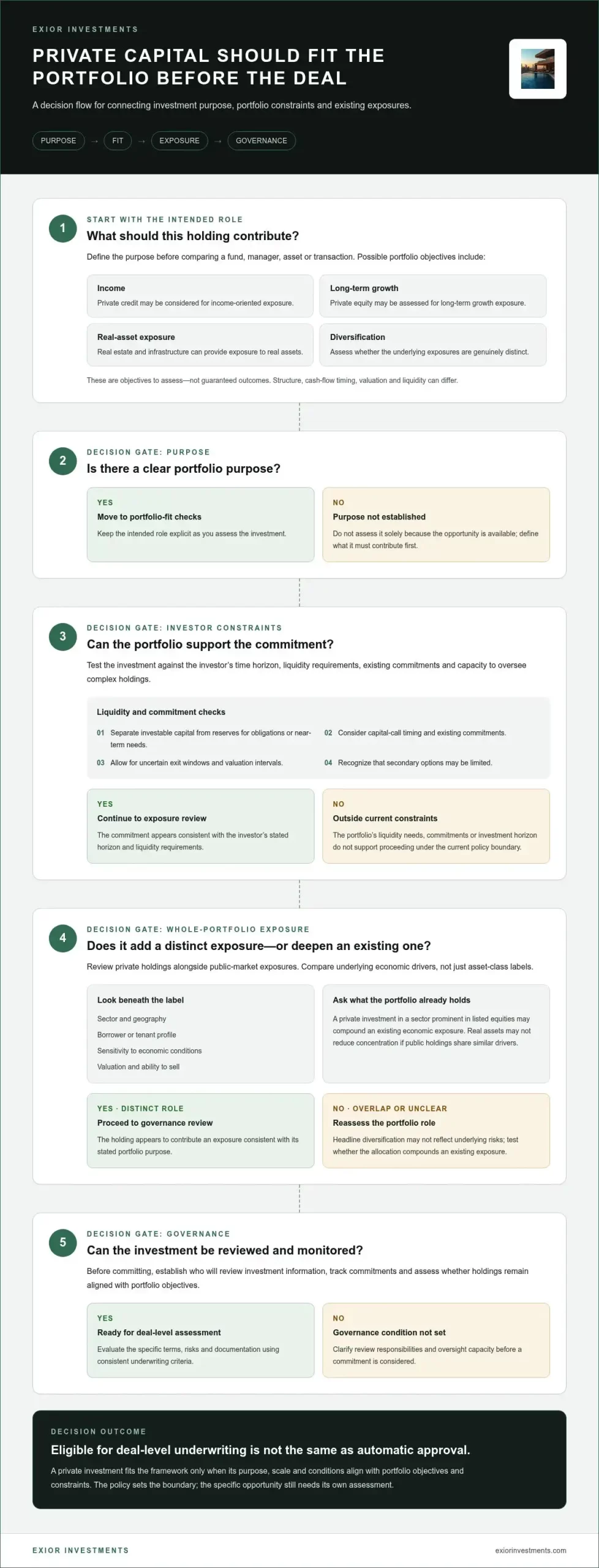
How to Build a Private Capital Allocation Strategy Step by Step
Define objectives. State what private investments are intended to contribute, such as growth, income, diversification, or real-asset exposure. Set priorities clearly enough to assess whether a proposed investment serves them.
- Map constraints. Record the investment horizon, liquid reserves, near-term obligations, existing commitments, and capacity to monitor holdings. Include relevant public and private exposures so apparent diversification can be tested against underlying concentration.
- Set allocation parameters. Establish exposure limits, concentration considerations, and conditions that require additional diligence or approval. Ranges and scenario analysis can illustrate how the policy responds to different circumstances, but they shouldn’t be treated as suitable percentages for every investor.
- Assess each opportunity. Apply consistent underwriting to the investment thesis, structure, risks, counterparties, cash-flow assumptions, and downside scenarios. Compare assumptions with available evidence, analysis, and appropriate benchmarks.
- Review and update. Schedule reviews and define triggers for reconsideration, such as a material change in liquidity needs, commitments, portfolio exposure, or the investment thesis. A review can test alignment without assuming that a private asset has been continuously repriced.
Which inputs belong in an allocation policy?
How should investors assess and review opportunities?
This framework strengthens the quality of opportunity-level decisions without removing investment risk. For investors in the UAE aligning portfolio objectives with private-capital or real-asset opportunities, explore tailored portfolio advisory to structure that analysis around the investor’s broader position.
Putting Private Capital Allocation Into Practice With Tailored Advisory
How can advisory support connect strategy and execution?
What should an investor prepare before a strategic discussion?
- Objectives: The role private investments are intended to play in the broader portfolio.
- Portfolio context: Existing exposures and commitments that may affect concentration or capacity.
- Liquidity requirements: Reserves, anticipated obligations, and the period over which capital may be committed.
- Decision process: Who participates, how approvals are made, and what governance or review arrangements are in place.
- Open questions: Areas requiring further analysis, including structure, downside risks, oversight, and portfolio fit.
For investors in the UAE refining a private capital allocation strategy, a measured discussion with EXIOR Investments can begin with portfolio objectives and constraints, then consider how relevant private-capital or real-asset analysis may support them. The focus is disciplined assessment and tailored advice, with each opportunity evaluated on its own merits.
Put Your Allocation Framework Into Practice
A disciplined private capital allocation strategy begins with portfolio purpose, not the appeal of a single opportunity. Define the role private investments should play, set allocation parameters around liquidity and existing exposures, and apply consistent underwriting before committing capital.
Bring your priorities, existing exposures, liquidity requirements, and open questions into the conversation. Arrange a private discussion with EXIOR Investments to consider how disciplined allocation can inform your next decisions. A clear framework is a strong foundation for investing with greater intention.
Frequently Asked Questions
What is a private capital allocation strategy?
How should investors decide how much capital to allocate to private investments?
Is private capital suitable for investors who need liquidity?
What should a private capital allocation framework include?
Can private investments diversify a portfolio?
How often should investors review private capital allocations?
What risks should investors assess before allocating private capital?

Private Investments Versus Public Markets: A Strategic Comparison for 2026
Reblogged from exiorinvestments.com Originally published at: https://exiorinvestments.com/private-investments-capital-advisory-strategy/The content below is
Private Capital Allocation Strategy: A Framework for 2026
Reblogged from exiorinvestments.com Originally published at: https://exiorinvestments.com/private-capital-allocation-strategy-a-framework-for-2026/The content below is

Private Capital Investment Dubai: Strategic Guide
Reblogged from exiorinvestments.com Originally published at: https://exiorinvestments.com/private-capital-investment-dubai-strategic-guide/The content below is

Frank’s Fearless Forecast: Bugatti Residences by Binghatti – The Ultimate Trophy Asset?
Reblogged from exiorinvestments.com Originally published at: https://exiorinvestments.com/bugatti-residences-by-binghatti-uhnwi-investors/The content below is

Dubai Luxury Real Estate Investment: What Makes a Luxury Property a Good Investment — Not Just an Expensive One
Reblogged from exiorinvestments.com Originally published at: https://exiorinvestments.com/dubai-luxury-real-estate-investment/The content below is

Frank’s Fearless Property Forecasts: Sobha SeaHaven
The 6-bedroom penthouse at Sobha SeaHaven in Dubai Harbour represents